Showing posts with label Hyundai Kona. Show all posts
Thursday, April 23, 2020
Hyundai's Making a "Hot" Version of the Kona SUV
While Subaru’s been busy making their Forester more mainstream (i.e. boring), Hyundai is heading in the opposite direction. Aside from giving their Tucson the N Line treatment, the Korean carmaker is gearing up for a Kona N.
At this point, Hyundai hasn’t revealed solid details about the Kona N, but several prototype mules have been spotted running around not just at its namesake, the Nürburgring racetrack, but at snow-packed test circuits as well. With that, it’s likely this high-performance variant of the Kona will pack all-wheel drive.
As for the powertrain, speculations have been running wild to include a new 2.5-liter Theta III Smartstream engine putting out 300 horsepower. However, at this point sharing the Veloster N’s 250-horsepower 2.0-liter unit seems like a safer bet.
Additional grunt aside, the Kona N will carry beefier brakes and larger wheels.
The Kona N also looks to paint the sub-compact crossover’s trademark cladding in body color while also sprouting a larger rear spoiler. Exposed dual exhaust will complete the changes outside.
With the prototypes looking to be close to production ready, the Kona N is expected to bow sometime late this year as a 2021 model.
Friday, January 17, 2020
The Hyundai Kona is Now a Guinness World Record Holder
The Hyundai Kona has earned its place in the Guinness World Records by breaking the world record for the highest altitude climb done in a fully electric vehicle or EV.
Driven up Sawula Pass in Tibet, the Kona Electric climbed up to 5,731 meters, passing the previous record of 5,715.28 meters. The Kona Electric that achieved the Guinness Record is made in India—the first-ever all-electric SUV made there.
With this feat, the Kona Electric has proven itself as a truly reliable EV in extreme conditions. During the expedition, Kona Electric performed as a true SUV on harsh weather conditions like low temperatures, continuous snowfall, and icy terrain.
During the record-breaking run, it was charged through the convenient portable chargers. The car was charged overnight with the standard portable charger provided along with the vehicle. No performance issues were found while climbing the peaks. While descending from peaks, the smart power regeneration system in the vehicle complimented the driving range.
The conquest personifies the Kona Electric’s powerful performance and assurance of its range and capability to outperform in any weather condition across extreme geographies and demographics.
In the Philippines, Hyundai Asia Resources, Inc. is selling the Kona Electric via indent order. It’s priced at P 2,388,000.
Filed Under:
Electric Vehicles (EV),
Hyundai Corporate,
Hyundai Kona,
News
Friday, November 15, 2019
2020 Kia Seltos vs Hyundai Kona vs Honda HR-V vs Subaru XV
With the Seltos, Kia Philippines thinks they have one of the hottest rides around and who could blame them? The sub-compact crossover segment is absolutely lit with choices and everyone, and we mean everyone wants a piece of the action—including Chinese brands you probably haven’t even heard of.
But of course, Kia’s not going that route. Leave the sub-million crossovers to the JACs, GACs, BACs, DACs, and whatever “ACs” there are in the world. Instead, the Seltos is targeting market space occupied by more premium choices—you know, against the likes of the Honda HR-V, Subaru XV, and its platform twin, the Hyundai Kona.
Let’s see how it stacks up.
Sporting a 2.0-liter 4-cylinder engine from Hyundai/Kia’s “Nu” family, the Seltos makes 149 horsepower and 179 Nm of torque—figures that are actually very comparable with the rest of the segment, including the Honda HR-V’s 1.8-liter mill. The Subaru XV’s 2.0-liter Boxer does edge the rest in grunt, but that’s negated by having to carry close to 200 kilograms of more weight because of its all-wheel drive drivetrain.
Apart from its drivetrain advantage, the Subaru is the only one in this group to offer independent suspension at all four corners and even vented disc brakes, too. It also has the largest tire size in the group at 225/55 R 18s, while the rest ride on exactly the same size of rubber: 215/55 R 17s.
Exterior-wise, the Subaru XV is also largest in this group, sports the largest wheelbase, and has the highest ground clearance, but it’s quite surprising that the Seltos (and the Kona) matches the Subaru in overall width and height.
Despite its exterior size advantage though, the Seltos does manage to optimize its interior very well. Aside from having best-in-group front and rear headroom, it does beat the Honda HR-V in terms of front leg and rear shoulder room. Compared to its mechanical twin though, the Seltos trounces the Kona in all but front leg room.
Priced at P 1.498-million, the Seltos (at least in SX trim) is the second most expensive model. Yet, a quick scan through the standard features shows it doesn’t really stand out in any department. Its convenience features are matched almost line-by-line to the Honda HR-V RS! At the polar opposites of this group are the Hyundai Kona at P 1.188 million and the Subaru XV at P 1.668-million. But it becomes a case of “you get what you paid for” with the Kona not even getting leather seats and reverse camera/sensors. On the other hand, the Subaru XV is the only one here with collision avoidance tech (Subaru EyeSight), powered driver’s seat, and a sunroof!
Feel free to nerd out with the rest of the specs below.
Filed Under:
Compact Crossover,
Feature,
Head-to-Head,
Honda HR-V,
Hyundai Kona,
Kia Seltos,
Subaru XV
Monday, July 8, 2019
Hyundai Adds Hybrid Powertrain to Kona Crossover
For a while, Hyundai only offered two kinds of Kona SUVs in the market: one propelled by a typical internal combustion engine, and one that swaps that for a battery electric motor. Now though, the Korean automaker has added a third option and one that bridges the gap between the two: meet the Kona Hybrid.
The introduction of the Kona Hybrid is, for Hyundai, a natural extension given it already has the tech in the Ioniq Hybrid. With that, the Kona Hybrid gets the same direct-injected 1.6-liter Kappa engine mated to a permanent magnet electric motor. It even has the same-sized battery: a 1.56 kWh lithium-ion polymer. Together, it makes 141 horsepower and 265 Nm of torque—numbers which are fairly close to the conventional 2.0-liter Kona. And like the Ioniq Hybrid, the Kona Hybrid also uses a 6-speed dual clutch automatic.
Along with the Hybrid drivetrain, Hyundai has thrown in some unique visual cues to differentiate the Kona Hybrid such as the white accents around the air vent surrounds and gear shift bezel, and the Gloss Black accents on the door handles, steering wheel, and air vent bezel. It also gets a gray headliner.
In Europe, where the Kona Hybrid will be sold first, it comes with Hyundai SmartSense, a safety suite which includes Front Collision Warning and Avoidance Assist, Smart Cruise Control with Stop & Go, Lane Following Assist, Lane Keeping Assist, and Blindspot Collision Warning.
The all-new Kona Hybrid will be sold starting August 2019.
Monday, May 20, 2019
Hyundai Philippines Slashes Price of Santa Fe and Grand Starex by P 100,000 this May
Summer’s almost over, but that’s not stopping from Hyundai Philippines offering some hot deals with their “Wheel It Sa Init” promo. From today until May 31, 2019, get discounts on some of their road trip ready vehicles such as the Grand Starex, Santa Fe, Tucson, H-100, and Kona.
For cash buyers, get the following discounts:
- Kona – P 70,000
- Tucson – P 100,000
- Santa Fe – P 100,000
- Grand Starex – P 100,000
- H-100 – P 50,000
All financing packages are inclusive of 1 year comprehensive insurance, 3-year LTO registration, free chattel mortgage, and standard freebies of tint, floor mats, and seat cover.
The promo is in partnership with BPI, RCBC, PNB, Chinabank Savings, Eastwest Bank, and PS Bank.
Filed Under:
Hyundai Corporate,
Hyundai Kona,
Hyundai Santa Fe,
Hyundai Starex,
Hyundai Tucson,
News
Thursday, April 4, 2019
Hyundai Electrifies MIAS and Confirms Local Availability of 2 EVs
Hyundai Asia Resources Inc., showcases their leadership in mobility solutions with the announcement that two electric vehicles will make their way to Philippine shores: the Kona Electric and the Ioniq Electric.
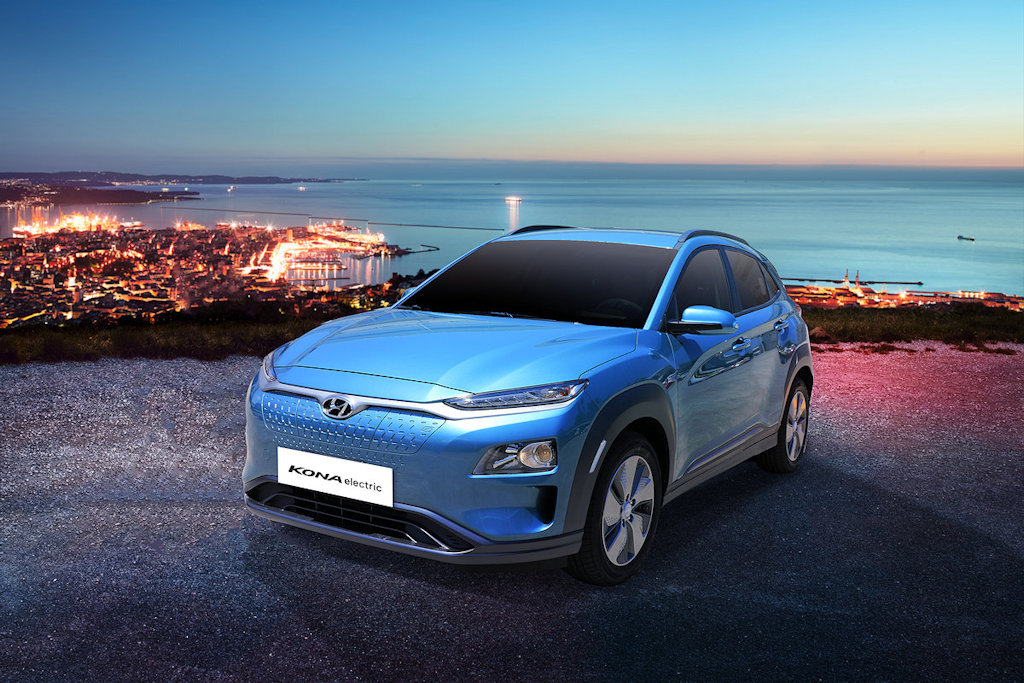
The Kona Electric is Hyundai’s first-ever all-electric compact crossover. Appealing to people with active, eco-focused lifestyles, it fuses an eye-catching exterior with confident handling, and of course, zero tailpipe emissions.
The Kona Electric employs organic geometric body forms and sporty contours for a modern, eco-oriented appearance. Its distinctive design is reinforced by the car’s voluminous, futuristic body styling. The front presents a future-focused, modern presence, with a cross-hatch, debossed design element for the grille area. The electric charging port is seamlessly integrated with this grille area for convenient, head-in parking at charging stations. The front view is flanked by aero-tuned flared fenders that enhance its road presence. It’s further enhanced by a separated-headlight design signature, with LED Daytime Running Lights above and available high-efficiency LED headlights below.
The sleek and simple interior accentuates the modern and efficient exterior design. The Kona Electric exclusive shift-by-wire drive controls are supported by a center console upper bridge element with an integrated open-access lower storage bin for convenience. The audio/navigation display incorporates advanced infotainment features.
The Kona Electric powertrain employs a high-efficiency 150-kW (201-horsepower) permanent-magnet synchronous electric motor supplied by a high-voltage 64 kWh lithium-ion battery. It should offer 415 kilometers on a single charge as well.
It was developed with a focus on enhanced driving dynamics and responsive performance for a variety of urban and multi-surface driving conditions. The front suspension features a MacPherson strut system using an innovative sub-frame bushing design for enhanced comfort and reduced NVH. At the back, there’s a multi-link rear suspension design for overall agility, ride comfort, and stability with minimal ride vs. handling compromises.
The price of the Hyundai Kona Electric is pegged at P 2,388,000.
Meanwhile, the Ioniq is Hyundai’s electric vehicle built on a dedicated platform. The Ioniq offers a sleek, aerodynamic silhouette with a class-leading 0.24 Cd derived from carefully designed surfaces. Its fluid exterior shape and smooth air flow channels emphasize aerodynamic body lines and design forms.
The Ioniq Electric offers pure electric mobility with a 28 kWh lithium-ion polymer battery for an estimated driving range of 200 kilometers. The Electric motor has an estimated maximum output of 88 kW (120 horsepower) routed through a single-speed reduction gear transmission.
In keeping with its exterior, the interior of Ioniq captures the model’s futuristic qualities, with a ‘Purified High-tech’ design concept. A smooth, elegant and clutter-free theme and efficient use of interior space complements a logical, structured approach applied to the layout of controls for intuitive operation. Materials for the interior were chosen with an ecologically-sensitive focus and are used to create a simple and clean look throughout the car, giving the interior a sleek, light and purified feel.
The price of the Hyundai Ioniq Electric is pegged at P 1,868,000.
Filed Under:
Electric Vehicles (EV),
Hyundai Ioniq,
Hyundai Kona,
MIAS,
News
Monday, April 1, 2019
Hyundai is Going to Beat Nissan at Introducing the Philippines's First EV
Check out the launch story here.
It looks like Nissan won’t have honor of bringing in the Philippines’s first-ever electric vehicle (at least officially). It seems Hyundai Asia Resources, Inc. or HARI will beat them to the punch and get this, it’ll be a crossover—a body style that Filipino buyers just love.
Based on the teaser invite sent in, Hyundai’s going to hold a series of “Rockology” concerts during the duration of the Manila International Auto Show (MIAS). While they haven’t exactly said who’ll be performing, the graphic does show the Kona Electric. The grille-less design and long-span grille are just some clear telltale signs.
As a bit of a background, the Kona Electric offers a bold, fresh design with “extroverted color options” according to Hyundai. It features a “debossed” element in the grille and aero-tuned flared fenders for an enhanced road presence while cheating the wind with its 0.29 co-efficient of drag—impressive given it’s a crossover.
Even more impressive is that the Kona Electric offers a 150-kW (201 horsepower) permanent-magnet synchronous electric motor supplied by a high-voltage 64 kWh lithium-ion battery. All in all, it should offer up to 415 kilometers on a single charge—beating even the Nissan Leaf.
Together with its all-electric drivetrain, the Kona Electric focuses on a fun-to-drive experience. The front suspension has an innovative sub-frame for reduced NVH while at the back, it has a multi-link rear suspension.
Of course, Hyundai may have just taken the creative liberty to use the Kona Electric on their invite because of its eye-catching color and front fascia. But given how HARI also likes to beat other carmakers to the punch, it’s a strong bet we’ll actually see it (likely a preview) at MIAS.
Subscribe to:
Posts (Atom)