Slider


Search CarGuide.PH

Showing posts with label Honda Brio. Show all posts

Tuesday, February 4, 2020

This February, the Honda BR-V is More Affordable Than Either the Xpander or Rush


Honda Cars Philippines is continuing its offers on the City, BR-V, Brio, and CR-V this February with their “Drive to 2020” promo. Aside from cash discounts, some models are now available with an all-in low downpayment as low as P 10,000.

The following models are part of the Drive to 2020 promo:
  • City 1.5 VX+ Navi CVT: P 24,000 cash discount or P 10,000 all-in downpayment
  • BR-V 1.5 S CVT: P 30,000 cash discount or P 10,000 all-in downpayment
  • Brio 1.2 S MT: P 28,000 all-in downpayment
  • CR-V V Diesel 9AT: P 75,000 cash discount or P 35,000 all-in downpayment
Putting some perspective into this deal, the City 1.5 VX+ Navi CVT—the top-of-the-line variant is now just P 1,044,000 (from P 1,065,000) making it priced close to the Toyota Vios 1.5 G (SRP). Meanwhile, the BR-V 1.5 S CVT’s discount price of P 1,005,000 makes it more affordable than the top-the-line Mitsubishi Xpander or Toyota Rush.

The City 1.5 VX+ Navi CVT, BR-V 1.5 S CVT, and Brio 1.2 S MT are all available through a 10 percent special all-in cash-out with payment terms of 36 up to 60 months through BPI Family Savings Bank, RCBC, Security Bank Corporation, China Bank Savings, and Bank of Commerce only.

Meanwhile, the CR-V V Diesel 9AT is available through 15 percent or 20 percent low net cash out with payment terms of 36 up to 60 months through BPI Family Savings Bank, RCBC, Security Bank Corporation, East West Banking Corporation, Philippine National Bank, Philippine Savings Bank, China Bank Savings, Bank of Commerce, Sterling Bank of Asia, Maybank Philippines Inc., BDO Unibank, Inc., United Coconut Planters Bank, and Robinsons Bank only.

Other financing promo option offers are the Free One Month Amortization, available for 60 months payment term only and the Low Monthly Amortization, available for 15 percent and 20 percent all-in downpayment for 36 to 60 months payment term.

All these offers include three (3) year LTO Registration and Chattel Mortgage. Free one (1) year Comprehensive Insurance with Acts of Nature is also available through select bank partners.

Monday, January 6, 2020

The Honda BR-V is Cheaper Than the Mobilio This Month


Didn’t get a brand-new Honda last December? Well, don’t worry since Honda Cars Philippines has extended its “Cheers for Deals” promo this January. The deals include the BR-V which drops its price to a tad above a million pesos making it even more affordable than the Mobilio RS!

Even if you’re not interested in the BR-V, this month’s promo covers the City, Brio, Civic, and CR-V as well. This is how much you stand to save this month:


The City 1.5 VX Navi CVT, BR-V 1.5 S CVT, and Brio 1.2 S MT are all available through a 10 percent special all-in cash-out with payment terms of 36 up to 60 months through BPI Family Savings Bank, RCBC, Security Bank Corporation, China Bank Savings, and Bank of Commerce only.

The CR-V Touring Diesel 9AT and Civic 1.8 S CVT are available through 15 or 20 percent low net cash out with payment terms of 36 up to 60 months through BPI Family Savings Bank, RCBC, Security Bank Corporation, East West Banking Corporation, PNB Savings Bank, Philippine Savings Bank, China Bank Savings, Bank of Commerce, Sterling Bank of Asia, Maybank Philippines Inc., BDO Unibank, Inc., United Coconut Planters Bank, and Robinsons Bank only.

Other financing promo option offers are the Free One Month Amortization, available for 60 months payment term only and the Low Monthly Amortization, available for 15 and 20 percent all-in downpayment for 36 to 60 months payment term.

All these extended holiday offers include three (3) year LTO Registration and Chattel Mortgage. Free one (1) year Comprehensive Insurance with Acts of Nature is also available through select bank partners.

The offers are available until January 31, 2020 only.

Monday, December 16, 2019

Review: 2019 Honda Brio RS Black Top CVT


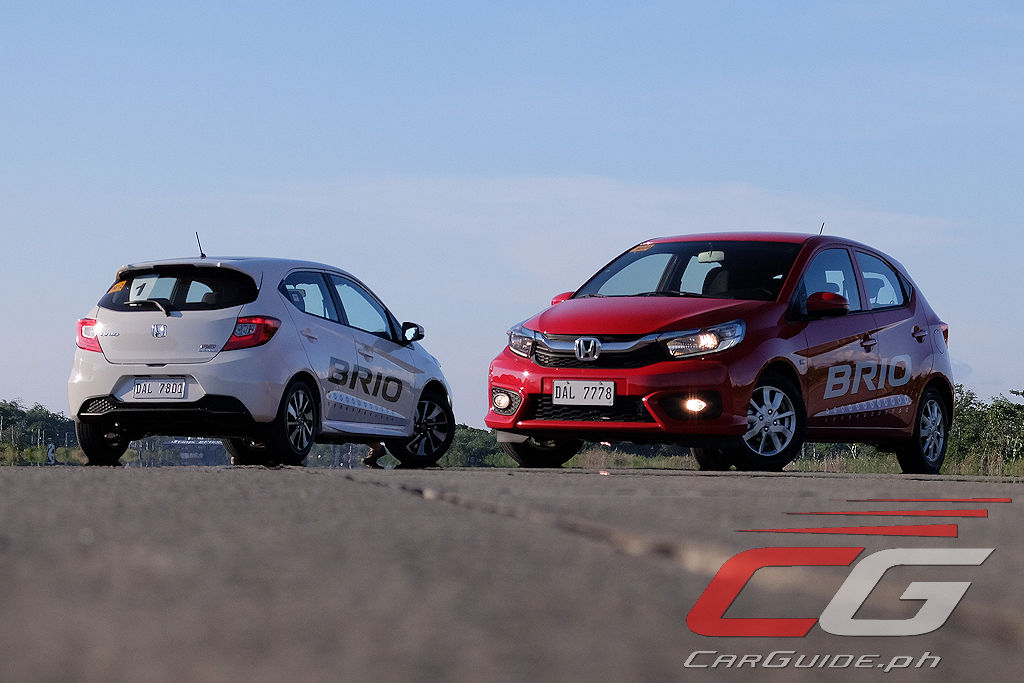
Small cars rarely get the love they deserve. Often seen as the lowest tier in motoring, they’re typically seen as rolling compromises—be it in design, comfort, or refinement. Yet, look carefully and you’ll find quite a few gems in the A-segment—the smallest of the small cars; and the brightest one among them? The 2019 Brio. It may be the most affordable offering in Honda’s stable, but it doesn’t make it less impressive.

Things start with the styling. Lengthened by close to 200 millimeters over the previous Brio, this new one looks less awkward now. It keeps the front doors from the first-gen model, but everything else is new. There are still some angles where it looks tall and skinny, but for the most part, it looks like a proper car now. The Mobilio headlights do well to visually widen the front, despite its identical width with its predecessor. At the back, a formal steel hatch removes the sourness that most people complained about before.


This top-trim RS variant also signifies Honda’s intention to bump the Brio above the average sub-compact hatchback; not that the standard model will ever be mistaken for a Grab car, mind you. But for an additional P 79,000 (P 84,000 with the optional Black Top) over the 1.2 V, it gets a unique grille and bumpers, an aero kit (with a tailgate spoiler to boot), and two-tone 15-inch wheels. It’s not the most practical upgrade, but it’s a nice aesthetic one for sure.

Despite carrying on with the first-generation Brio’s platform, the wheelbase’s been stretched by 60 millimeters. While that sounds like a minuscule number, it plays dividends in making the interior much more habitable. Jumping directly to the backseats, knees no longer scrape against the front seat anymore. The re-designed hatch also gives birth to more headroom, and with it, adjustable headrests. There’s a total of three in the back, but in all honesty, fitting two large-ish adults is the most comfortable. More impressive is the fact that the cargo bay’s grown by 83 liters allowing large pieces of luggage to fit in the back. The rear seats can also be collapsed for additional space too, but sadly, there’s no split-folding function here.


Improved as the Brio is from the back, it’s at the front where it shines. Borrowing the Mobilio’s angular dashboard, the lines and details make it look messy, but true to Honda form, it’s easy to use. While the seating position is upright and high, compared to other sub-compacts out there, it’s already sporty. The three-spoke steering wheel and no-nonsense gauges also help in its usability. Like the first-generation Brio, the seats look thin, but are supportive. The Brio also scores well for its sturdy construction, amount of storage spaces, and easy-to-use digital type air conditioner. However, it gets mixed scores for its infotainment system because the touchscreen’s hard to operate on the go (thankfully steering wheel controls is standard) and minus points for the omission of a foot rest and seat height adjustment.

Perhaps Honda’s gamble with the Brio is their decision to swap the previous generation’s 1.3-liter engine for a 1.2-liter one. The downsized motor gives up 10 horsepower and 17 Nm of torque in a car that weighs 22 kilograms more than the previous Brio. On the surface, it seems Honda’s levying a performance penalty to make it more affordable. Thankfully, that’s not the case. Not only is it an excellent punter around the city, but it’s still confident enough to hit the highways. Getting most out of the engine requires wringing the accelerator, but thankfully the engine is smooth (but vocal) at high rpms. Swapping the traditional automatic for a CVT results in a slight throttle delay, but fuel economy has improved significantly to 11.2 km/L to 11.7 km/L in urban traffic when compared to the old Brio.


With a carryover platform, that’s in turn, based off the first-generation Jazz, the Brio is actually fun to toss around corners. The steering has this immediacy that the chassis could match. This tandem makes the Brio a great dance partner—the only car in this price range confident enough to tackle winding roads and sweeping corners. The tires will chirp at times, and understeer is the name of the game, but overall, it’s actually quite fun. More importantly, it’s stable and secure even at triple digit speeds. What’s even better is that the ride doesn’t seem affected at all. While it’s a bit on the firm side, it’s never uncomfortable, and can actually absorb heavy potholes with no difficulty.

The name “Brio” means verve in Italian and with that, Honda’s managed to choose a very appropriate name. Just as the first-generation Brio presented itself as a fun-to-drive small car, this second-generation model successfully builds on that, while also rectifying its predecessor’s shortcomings. As a result, the Brio sure feels like an overengineered car, and with that enthusiasts will reap the benefits by getting a car that far exceeds the expectations in its class in all aspects.


2019 Honda Brio RS Black Top
Ownership 2019 Honda Brio RS Black Top CVT
Year Introduced 2019
Vehicle Classification Sub-compact Hatchback
Warranty 3 years / 100,000 kilometers
The Basic
Body Type 5-door Hatchback
Seating 5
Engine / Drive F/F
Under the Hood
Displacement (liters) 1.2
Aspiration Normally Aspirated
Fuel Delivery EFI
Layout / # of Cylinders I4
BHP @ rpm 90 @ 6,000
Nm @ rpm 110 @ 4,800
Fuel / Min. Octane Gasoline / 91~
Transmission CVT
Cruise Control No
Fuel Economy @ Ave. Speed 11.2 km/L @ 12 km/h,
11.7 km/L @ 16 km/h
Dimensions and Weights
Length (mm) 3,815
Width (mm) 1,680
Height (mm) 1,485
Wheelbase (mm) 2,405
Curb Weight (kg) 992
Suspension and Tires
Front Suspension Independent, MacPherson Strut
Rear Suspension Torsion Beam Axle
Front Brakes Vented Disc
Rear Brakes Drum
Tires Bridgestone Potenza 030 185/55 R 15 V (f & r)
Wheels Alloy
Safety Features
Airbags 2
Anti-Lock Brakes (ABS) Yes, with EBD
Traction / Stability Control No
Parking Sensors No
Front Seatbelts 3-pt ELR with pre-tensioner x 2
Rear Seatbelts 3-pt ELR x 2, 2-pt lap belt x 1
ISOFIX Child Seat Anchor Yes
Other Safety Features No
Exterior Features
Headlights Halogen
Fog Lamps Yes, Front
Auto Lights No
Rain-sensing Wipers No
Interior Features
Steering Wheel Adjust Tilt
Steering Wheel Material Urethane
Seating Adjustment (driver) Manual, 4-way
Seating Adjustment (front passenger) Manual, 4-way
Seating Surface Fabric
Folding Rear Seat Yes
On-Board Computer Yes
Convenience Features
Power Steering Yes
Power Door Locks Yes
Power Windows Yes
Power Mirrors Yes, with Fold
Proximity Key No
Climate Control Manual
Audio System Stereo
Aux
USB
Bluetooth
# of Speakers 6
Steering Controls Yes

Wednesday, December 4, 2019

Get the Honda Civic 1.8 S for Just P 1.065-Million This Christmas


Still don’t know what to get this Christmas? How about a brand-new Honda? Honda Cars Philippines is announcing an extension of its Cheers for Deals promo. The promo covers the City, BR-V, CR-V, Brio and Civic with the following cash discounts and low downpayment offers:


The City 1.5 VX Navi CVT, BR-V 1.5 S CVT, BR-V 1.5 Prestige CVT, Brio 1.2 S MT, and Brio 1.2 RS CVT are all available through a 10 percent special all-in cash-out with 36 up to 60 months payment term through BPI Family Savings Bank, RCBC, Security Bank Corporation, China Bank Savings, and Bank of Commerce only.

On the other hand, the CR-V Touring Diesel 9AT and Civic 1.8 S CVT are available through 15 percent or 20 percent low net cash out with 36 up to 60 months payment term through BPI Family Savings Bank, RCBC, Security Bank Corporation, East West Banking Corporation, PNB Savings Bank, Philippine Savings Bank, China Bank Savings, Bank of Commerce, Sterling Bank of Asia, Maybank Philippines Inc., BDO Unibank, Inc., United Coconut Planters Bank, and Robinsons Bank only.

Moreover, other financing promo option offers are the Free One Month Amortization, available for 60 months payment term only and the Low Monthly Amortization, available for 15 percent and 20 percent all-in downpayment for 36 to 60 months payment term.

All offers include three (3) year LTO Registration and Chattel Mortgage. Free one (1) year Comprehensive Insurance with Acts of Nature is also available through select bank partners.

The promo is extended up to December 31, 2019.

Monday, November 4, 2019

The Honda CR-V Touring Gets You a P 107k Discount and Free Gas Too!


Honda Cars Philippines, Inc. (HCPI) announces an early Christmas promotion entitled Cheers for Deals. The promo covers the City, BR-V, CR-V, Brio and Civic with the following cash discounts and low downpayment offers:

  • City 1.5 Sport CVT - P 15,000 cash discount or P 11,000 all-in downpayment
  • BR-V Prestige CVT - P 30,000 cash discount or P 10,000 all-in downpayment
  • Brio 1.2 S M/T - P 28,000 all-in downpayment
  • Civic 1.8 S CVT - P 50,000 cash discount or P 38,000 all-in downpayment
  • CR-V Touring Diesel 9AT - P 107,000 cash discount + P 10,000 free fuel or P 10,000 all-in downpayment
The City 1.5 Sport CVT, BR-V 1.5 Prestige CVT, and Brio 1.2 S MT are all available through a 10 percent special all-in cash-out with up to 60 months payment term through RCBC Savings Bank, China Bank Savings, Bank of Commerce, BPI Family Savings Bank, and Security Bank Corporation only.

On the other hand, the CR-V Touring Diesel 9AT and Civic 1.8 S CVT are available through 15 percent low net cash out with up to 60 months payment term through BPI Family Savings Bank, RCBC Savings Bank, Security Bank Corporation, East West Banking Corporation, PNB Savings Bank, Philippine Savings Bank, China Bank Savings, Bank of Commerce, United Coconut Planters Bank, Sterling Bank of Asia, Maybank Philippines Inc., BDO Unibank, Inc., and Robinsons Bank only.

All offers include three (3) year LTO Registration and Chattel Mortgage. Free one (1) year Comprehensive Insurance with Acts of Nature is also available through select bank partners.

Promo runs until November 30, 2019.

Tuesday, September 24, 2019

The Brio is Now Honda Cars Philippines's Third Best-Selling Model


After getting hit hard by the implementation of the new vehicle excise tax in 2018, Honda Cars Philippines President and General Manager Noriyuki Takakura reveals that the Japanese automaker believes that they’ve put the worst behind them.

“The Philippine Automotive Industry is now on its road to recovering from the impact of the excise tax implementation back in 2018,” says Takakura.

Honda’s brightest spot was also its most affordable model, the all-new Brio. Launched in April of this year, the Brio now holds a 19 percent share in the A-segment category. In fact, it current is the brand’s third best-selling model, just behind the City and BR-V.

Takakura credits this to the Brio’s sporty exterior, fuel engine, and affordable price. And to answer its continued popularity, he announced that HCPI is increasing their stock of the all-new Brio in order to reduce waiting time for customers.

Along with the strong performance of the Brio, Takakura says its BR-V and Civic are also performing strongly in their respective segments. The Civic, in particular, holds an astounding 55 percent market share in the compact car segment as of August.

Moving forward, Takakura says Honda Cars Philippines will continuously improve their product line-up to cater to the diverse needs of the Filipino customer.

Monday, September 23, 2019

Review: 2019 Honda Brio 1.2 V CVT


As the smallest car in the Honda line-up, the Brio arrived without much ado, but with all the makings of a traffic stopper. Primarily because of its bright, canary yellow color, but also because of its immediate no-nonsense appeal. Rather than the Jazz, which is closer to its size, it gives off a more conservative vibe that is like their elder—the Honda CR-V. The similarities are astounding and the imagery is similar—practical, reliable, but also sporty and a risk-taker. While it’s far from perfect, the Brio is one to love and may, perhaps, become your next favorite ride.

The minute the Brio arrived in our driveway, there was instant attraction. Apart from the cheery color, what made the car appealing was its friendly design. Unlike the Jazz, whose appeal lies in its sporty heritage, the Brio is more like the CR-V—that familiar childhood best friend all grown up, but still ready to take on memory lane on any given day. The familiarity starts from its boxy front side with the rounded, slightly jutting bumper. This design is proportioned all the way to its wide window frames, ending at its rounded hatchback. Overall, you are looking at a look that is basic and young, but sporty.


If there was anything that I would improve in terms of design, it would be the 14-inch alloy wheels. While the Brio was clearly made to be an entry-level model in its category, the stock design does not do justice to the youthfulness of vehicle. In fact, to the more discerning car owner, nevermind age, it may be one of the first things to upgrade as soon as the car rolls out of the dealership.

The interior of the Brio is as basic as basic gets, with the plastic finish of the dashboard and the fabric upholstery of the seats. It’s all very well-made, however, and the interior layout holds true to the signature practicality of every Honda vehicle. Each control point is in its proper and predictable place, right down to the 7-inch infotainment system that is built with a USB charging port, and sits atop the climate control switches. Again, there is next to nothing special in the looks department, precisely because what is extraordinary lies in the car’s practical features.


Practical is an understatement for the Brio as this little car proved to have quite the capacity in both seating and cargo. Starting with the front row, there is little to no cramping for the driver. The height of the vehicle makes ingress and egress smooth and easy, although the seat’s angling toward the backside could get uncomfortable in long drives. Legroom is generous, both toward the front and sideways—wiggle room for the backside is always a plus, as this extends all the way up to shoulder support, allowing the driver to have a more supple seated posture. The passenger, on the other hand, enjoys even more comfort, with the ability to do a full leg stretch at its maximum length.

Moving on to the second row, the Brio can easily seat three petite individuals or two average Filipino males. Even with the front row seats extended halfway, passengers in the back seat can have a good leg angle despite the seemingly small cabin. This makes it perfect for small group outings and a regular city commute.


Seating is one thing, but cargo is another. Surprisingly, this compact-looking Brio can hold more than just daily baggage. With the back seat folded up, 258 liters of hold can fit just about 2 carry-ons and a duffel bag. But with the seats folded down, cargo space triples to 710 liters. To get a better perspective, I was able to transport a full-sized terrarium. Granted, there won’t be any excess space left, nor room for backseat passengers, but that’s quite a tall order that a compact car was able to fulfill.

With every Honda, there is a certain expectation when it comes to performance. The Brio did not disappoint. Having gone through most of the new vehicles under the Honda product range, it can stand up to its brothers, like the Jazz and the Civic. Sure, it lacks that sporty appeal and the punch, but even on just a 1.2-liter engine, it was torquey and can manuever well through the city streets. Clearly, it could use more power. Even with a peppy engine, it was challenging to climb up steeper parking ramps, the likes of Greenbelt 3. However, what it lacked in power, it made up for in a smooth driving experience. The steering was light and easy and the responsiveness was pure Honda. It won’t win any trophies, but it will safely take you where you need to go.

The Honda Brio was a refreshing surprise. While there wasn’t much to see at first, considering that it was not even on an electronic start/stop engine, it proved to have more to offer than a bright exterior. Coming from a week’s worth of bonding, I conclude that this was a car made with the urban dweller in mind, more than a long road traveler.

Words and photos by Gen Tiu.


2019 Honda Brio 1.2 V
Ownership 2019 Honda Brio 1.2 V CVT
Year Introduced 2019
Vehicle Classification Sub-compact Car
Warranty 3 years / 100,000 kilometers
The Basics
Body Type 5-door Hatchback
Seating 5
Engine / Drive F/F
Under the Hood
Displacement (liters) 1.2
Aspiration Normally Aspirated
Fuel Delivery EFI
Layout / # of Cylinders I4
BHP @ rpm 90 @ 6,000
Nm @ rpm 110 @ 4,800
Fuel / Min. Octane Gasoline / 91~
Transmission CVT
Cruise Control No
Fuel Economy @ Ave. Speed --
Dimensions and Weights
Length (mm) 3,800
Width (mm) 1,680
Height (mm) 1,485
Wheelbase (mm) 2,405
Curb Weight (kg) 969
Suspension and Tires
Front Suspension Independent, MacPherson Strut
Rear Suspension Torsion Beam Axle
Front Brakes Vented Disc
Rear Brakes Drum
Tires Dunlop Enasave EC300+ 175/65 R 14 T (f & r)
Wheels Alloy
Safety Features
Airbags 2
Anti-Lock Brakes (ABS) Yes, with EBD
Traction / Stability Control No
Parking Sensors No
Front Seatbelts 3-pt ELR with pre-tensioner x 2
Rear Seatbelts 3-pt ELR x 2, 2-pt Lap Belt x 1
ISOFIX Child Seat Anchor Yes
Other Safety Features No
Exterior Features
Headlights Halogen
Fog Lamps Yes, Front
Auto Lights No
Rain-sensing Wipers No
Interior Features
Steering Wheel Adjust Tilt
Steering Wheel Material Urethane
Seating Adjustment (driver) Manual, 4-way
Seating Adjustment (front passenger) Manual, 4-way
Seating Surface Fabric
Folding Rear Seat Yes
On-Board Computer Yes
Convenience Features
Power Steering Yes
Power Door Locks Yes
Power Windows Yes
Power Mirrors Yes
Proximity Key No
Climate Control Manual
Audio System Stereo
Aux
USB
Bluetooth
# of Speakers 4
Steering Controls Yes

Tuesday, September 3, 2019

Honda BR-V, Brio Break 22 km/L in Fuel Economy Run


Honda Cars Philippines, Inc. (HCPI) put the refreshed BR-V and all-new Brio on a fuel economy run to see how much mileage they can squeeze out of their fuel tanks. In partnership with the Automobile Association of the Philippines (AAP) we now know efficient they can be.

Fielding in the Honda Brio 1.2 V CVT, and the Honda BR-V 1.5 S CVT, it achieved 24.5 km/L and 22.58 km/L, respectively after being driven a total of 231.45 kilometers on the highway at night.

To ensure that the two vehicles were tested under realistic driving conditions, HCPI and AAP set the following parameters:
  • Speed at 60-80 km/h, with engine revs at 1,500 to 2,000 rpm
  • Aircon set at 50% cool at Blower Fan Speed 1
The BR-V’s fuel consumption result proved remarkable given its power rating of 120 horsepower. While the Rush has yet to be tested under the same conditions, it is worth noting that the BR-V’s did not beat its sister car, the Mobilio’s 24.69 km/L. In addition, the Xpander narrowly beat the BR-V in a similar fuel economy run with a fuel economy figure of 22.94 km/L.

On the other hand, the Brio is expected to achieve great fuel efficiency given its small engine. But it still manages to provide superb drivability, and excellent legroom.

This fuel economy run is an initiative of Honda Cars Philippines Inc., as supervised and certified by Automobile Association of the Philippines (AAP) with the objective of providing customers accurate and relevant information to aid in their car selection process. By knowing the fuel rating of these vehicles achieved through realistic conditions, customers will be able to make informed and intelligent decision in their car purchase.

Tuesday, June 25, 2019

Honda Cars President Expects Upbeat 2019 Thanks to All-New Brio, New BR-V


Noriyuki Takakura, Honda Cars Philippines President and General Manager says the Japanese automaker expects an upbeat year ahead despite the challenging economic climate thus far.

“As you very well know, the automotive industry continues to face challenges since 2018. This includes factors such as excise tax, unfavorable foreign currency, and inflation. Nevertheless, despite these challenges, we remained positive and continued to serve our customers with joy with our Honda top quality products that enhance their lives,” said Takakura-san.

In fact, for the first five months of 2019, Honda Cars Philippines has so far sold a total of 8,660 units. This is composed of 5,030 units in the Passenger Car segment and 3,630 units in the Commercial Vehicle segment.

One of the biggest factors to HCPI’s strong showing thus far is the sales of the all-new Brio. After its launch just last April 23, Takakura-san said they have sold over 610 units thus far, translating to a 1,257 percent increase versus its predecessor year-on-year.

Moreover, HCPI is banking on the continued success of the newly-launched BR-V. Since its Philippine market launch in September 2016, it has sold more than 14,500 units making it the second best-selling nameplate for Honda locally. And furthering its commitment to serving its Filipino customers, Takakura-san says there will be no waiting time for the new model.

“Last year, as part of our commitment to help grow the Philippine automotive industry, and as support to all our associates, we have decided to produce the BR-V here in the Philippines. This also means the BR-V will always be available to our customers with no waiting time,” says Takakura-san.

Wednesday, May 22, 2019

First Drive: 2019 Honda Brio 1.2 CVT


Pause for a minute and imagine everything that a small car is. Ugly, terrible to drive, cramped—these are just some of the words used to describe what’s commonly considered as the lowest tier in motoring: the sub-compact or A-segment car. Now, open your eyes and see the 2019 Honda Brio. It’s the most affordable car in Honda’s stable, yet it manages to adhere to everything the Japanese carmaker stands for. It is, if you will, the “un-small small car.”


Everything starts with the styling. Compared to the startled look of the first-generation Brio, this new one looks every inch more refined. Lengthened by close to 200 millimeters, the stance is less awkward now. It keeps the front doors from the first-generation model, necessitating the continuation of that sharp side crease, though everything else is new. There are still some angles where it looks tall and skinny, but for the most part, it looks great. The Mobilio headlights do well to visually widen the front, despite the identical width with its predecessor, while the formal steel hatch at the back removes the sourness that most complained about before.


Despite carrying on with the first-generation Brio’s platform, the wheelbase’s been stretched by 60 millimeters. While that sounds like a miniscule number, it plays dividends in making the interior much more habitable. Jumping directly to the back, knees no longer scrape against the front seats anymore. The re-designed hatch also gives birth to more headroom, and with it, adjustable headrests. There’s a total of three in the back, but in all honesty, fitting two regular-sized motoring journos is the most possible. Even more impressive is the larger cargo hold. Grown by 83 liters, it now allows large pieces of luggage to fit without having to reduce the passenger count to two (there’s no split-folding function here).

Improved as the Brio is from the back, it’s from the front where it truly shines. Borrowing the Mobilio’s angular dashboard, it’s straightforward to use. Compared to other sub-compacts out there, the seating position is lower and sportier, aided by a well-positioned meaty three-spoke steering wheel and easy-to-read gauges. Like the first-generation Brio, the seats have fixed headrests (except for the RS), but are comfy even for long drives. The Brio scores big for its sturdy construction, amount of storage spaces, and easy-to-use digital type air conditioner while it gets minus points for its tough-to-operate infotainment system (thankfully steering wheel controls are standard) and footrest omission.


Perhaps Honda’s gamble is their decision to swap the previous generation’s 1.3-liter engine for, get this, a 1.2-liter one. The downsized motor gives up 10 horsepower and 17 Nm of torque in a car that weighs just 1 kilogram lighter than before (22 kilograms more with the RS). On the surface, it seems Honda’s levying a performance penalty to make it more affordable, but thankfully, that’s not the case.

Getting the most out of the engine still requires wringing the accelerator, but it’s confident enough to hit the highways. It can feel taxed with three people and luggage onboard, but the engine isn’t at all vocal thanks to impressive NVH; plus it’s smooth and refined even at high rpms. Swapping the traditional automatic for an Earth Dreams CVT should have dulled the responses, but it's actually quite the opposite. It picks up speed pretty quickly, at least until the needle reaches 120 km/h. Fuel economy is also good, registering 14.5 km/L in a mixed city/highway route (about 10 km/L in the city).


With a carryover platform, that’s in turn, based off the first-generation Jazz, the Brio keeps its crown as the best handling A-segment car. The steering has this immediacy that the chassis could match. This tandem makes the Brio a great dance partner; the only car in this price range confident enough to tackle winding roads and sweeping corners. What’s even better is the ride hasn’t been affected at all; it’s actually softer than the previous generation while also being impervious to road cuts or potholes.

The name “Brio” means verve in Italian and with that, Honda’s managed to choose a very apt name. Just as the first-generation Brio presented itself as a fun-to-drive small car, this second-generation model successfully continuous that trend. Honda’s penchant for making a well-engineered car continues here, and with that, enthusiast will reap the benefits by having a choice with qualities that exceed its class.


Sidebar Title

Main Tab Menu